 Podcast
In this episode of Missiology Podcast, Martin Rodriguez talks with Greg McKinzie about his book The Hermeneutics of Participation: Missional Interpretation of Scripture and Readerly Formation. Together they explore why biblical interpretation is never neutral, how participation in God’s mission forms the church as a reading community, and what it means for congregations to read Scripture faithfully as they join God’s work in the world. Along the way, they discuss theological interpretation, missional hermeneutics, theōsis, solidarity, and the formation of faithful readers.
The Book
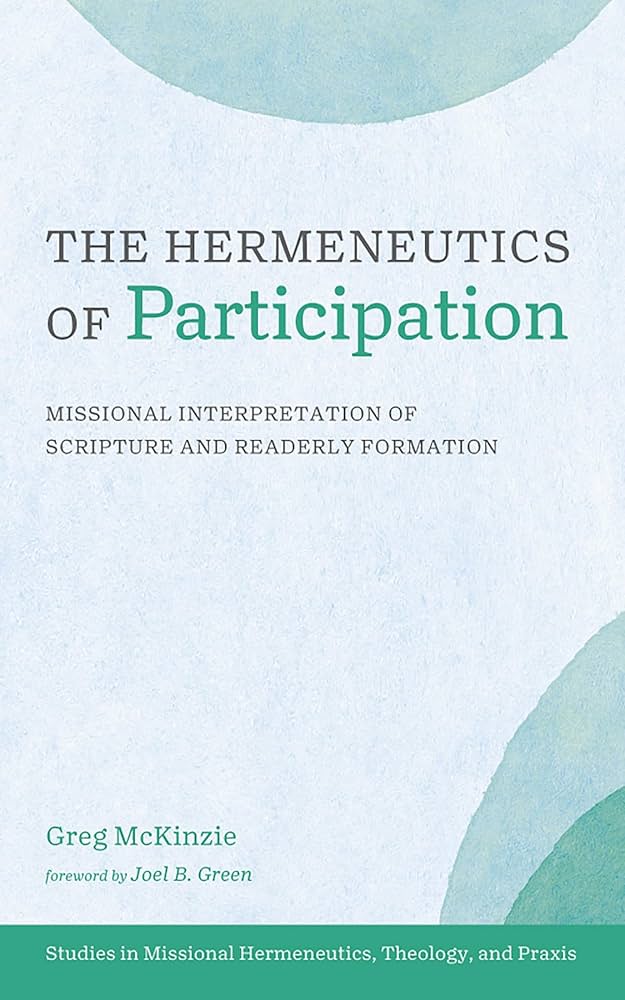 The title The Hermeneutics of Participation captures the book’s double movement: McKinzie offers both a hermeneutic of participation—an account of what participation in God’s mission means—and a hermeneutic through participation, showing how the church learns to read Scripture more faithfully as it is drawn into God’s mission. In other words, McKinzie both interprets participation and shows how participation becomes hermeneutical, forming the church’s perception, imagination, and capacity to read.
McKinzie begins with a tension in missional hermeneutics. Scholars often affirms that Scripture should be read by communities participating in God’s mission, yet the meaning of participation often remains vague. What does “participation in God’s mission” actually mean? And why should participation form better readers of scripture?
McKinzie answers by arguing that mission is not simply an activity of the church or merely the application of interpretation. Mission is a site where God reshapes the church’s habits, desires, practices, relationships, and interpretive imagination. To develop this account, McKinzie brings missional theology, theological interpretation, theological anthropology, liberationist accounts of solidarity, and Ricoeurian hermeneutics into conversation. He shows that participation is neither abstract nor merely external action, but takes shape through theōsis, embodied narrativity, and solidarity.
The argument turns on a hermeneutical circle. Scripture forms the church for participation in God’s mission, and participation in God’s mission forms the church to return to Scripture with transformed perception. Mission, therefore, does not replace Scripture, nor does experience become an independent authority over Scripture. Instead, participation in God’s mission becomes a theologically necessary context in which the church’s “embodied eyes of faith” are opened.
What is on offer is a better way to read Scripture. McKinzie reframes “better readings” not merely as readings that are more technically precise, historically informed, or methodologically rigorous, but as readings born from communities whose lives are being transformed through participation in the life and mission of the Triune God.
Our Guest

Greg McKinzie is assistant professor in the Department of Bible, Missions, and Ministry at Abilene Christian University. He is also assistant editor of Missio Dei: A Journal of Missional Theology and Praxis and lead administrator of missiology.com.
His most recent book, The Hermeneutics of Participation: Missional Interpretation of Scripture and Readerly Formation, was published by Cascade Books in 2025. He is also co-author, with Mark E. Powell and John Mark Hicks, of Discipleship in Community: A Theological Vision for the Future (2020), and co-editor, with Christopher L. Flanders, of Missional Life in Practice and Theory: Essays in Honor of Gailyn Van Rheenen (2024).
Before joining the faculty at Abilene Christian University, McKinzie taught at Lipscomb University, served as a cross-cultural missionary in Arequipa, Peru, and worked as a missions minister at Stones River Church in Murfreesboro, Tennessee. He writes and podcasts regularly on theology, discipleship, mission, and missional hermeneutics at Theology on the Way. He holds a PhD in theology from Fuller Theological Seminary, an MDiv from Harding School of Theology in Memphis, Tennessee, and a BA in missions from Harding University in Searcy, Arkansas.
Credits
Hosted by Martin Rodriguez
Produced by Martin Rodriguez


